•
Finance
Building a High-Performance Patient Finance System
Chapter Six
The core problem: fragmented journeys destroy conversion
Most dental practices operate across disconnected steps:
enquiry
booking
consultation
quote
follow-up
Each step:
relies on humans
varies in quality
and introduces drop-off
Key insight
Conversion does not fail at one point.
It fails in the gaps between steps.
The solution: a continuous, system-driven journey
A high-performance patient finance system connects: every step from first contact to payment
Pillar 1: Capture every patient (AI front door)
The first failure point is access.
Most practices rely on:
phone calls
limited hours
manual handling
The reality
calls are missed
callbacks fail (70–80%)
context is lost
performance varies by individual
The shift
Move to: AI-first, always-on patient intake
What this enables
24/7 availability
no missed demand
consistent conversations
multi-channel access (call, chat, message)
Key insight: Every missed call is a lost high-value opportunity.
Pillar 2: Pre-qualify and educate before the visit
Before a patient arrives, AI can:
explain treatments
provide price ranges
introduce finance options
guide urgency (events, timelines)
Result
better-informed patients
higher intent
more productive consultations
Pillar 3: Capture the decision in the chair
This is where most practices lose momentum.
The traditional model
consultation happens
treatment plan is created later
quote is sent after the visit
The problem
delay breaks momentum
patients disengage
conversion drops
The high-performance model
capture and present a quote immediately in the chair
How this works
clinician discussion is captured (e.g. voice AI)
converted into a simple quote
not a complex treatment plan
Why this matters
Patients do not need:
full clinical detail
They need:
a clear price
and a clear next step
Key insight: Simplicity accelerates decisions.
Immediate payment options
At the point of quote:
card
Pay-in-3
finance
are presented instantly.
Result: Patients can commit immediately—without delay or follow-up dependency.
Pillar 4: Standardised payment system
At the moment of decision: variability must be eliminated.
Finance structure
12 months — 0%
24 months — low APR
36 months — higher APR
Additional layer
Pay-in-3 for lower-value treatments
Key rule: No customisation. No hesitation. No decision-making required.
Pillar 5: One application, one decision
Fragmentation kills conversion.
The wrong model
multiple applications
multiple lenders
multiple journeys
The correct model
one application → multiple outcomes
This includes:
prime lending
near-prime lending
Pay-in-3
Key insight: The patient should never have to apply twice.
Pillar 6: AI-powered follow-up
Most practices lose patients after the consultation.
Why
follow-ups are inconsistent
timing is poor
communication varies
The reality
calls are missed or mistimed
emails are delayed or ineffective
tone and quality vary
Key insight: Follow-up is one of the largest untapped conversion levers.
The high-performance model
AI-driven, structured follow-up on every quote
What this includes
outbound calls
messages
reminders
When it happens
evenings
weekends
when patients are actually available
What it does
revisits the quote
explains finance again
provides payment options
enables immediate action
Result
Patients convert when they are ready—not when the practice is available.
Pillar 7: Close the loop
The system must allow:
immediate payment
finance completion
or booking
Not:
“call us back”
“let us know”
But:
Complete the journey in one continuous flow
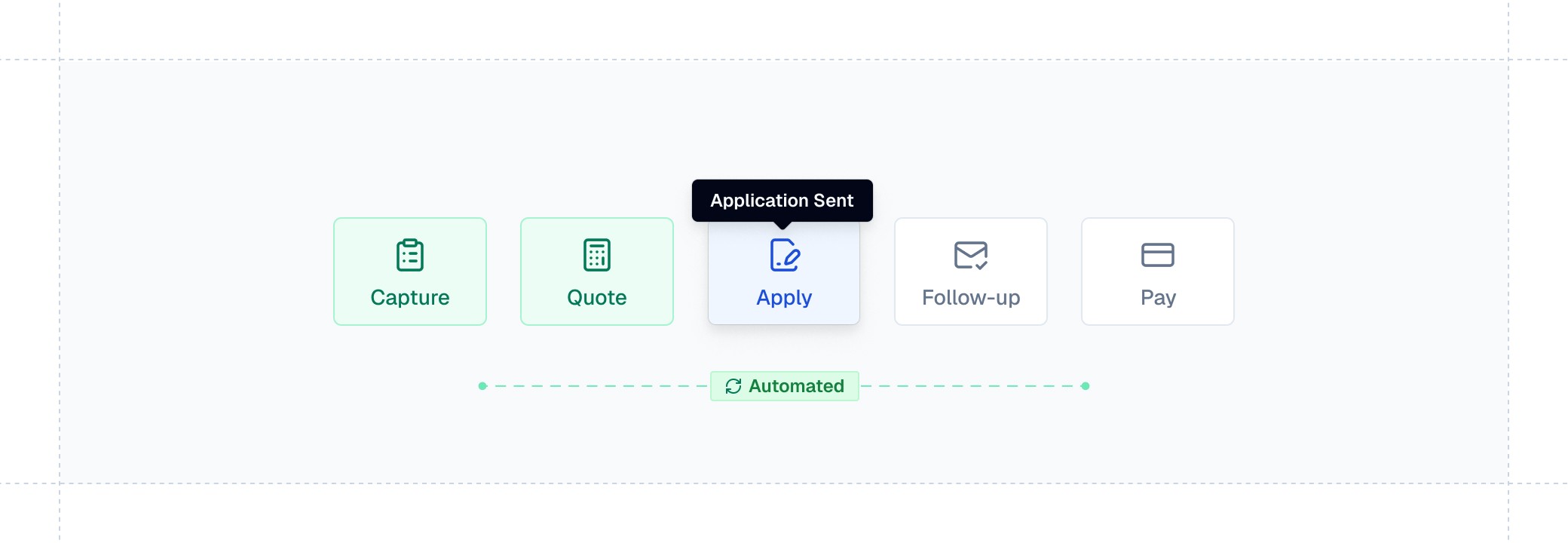
The system end-to-end
A high-performance system operates as follows:
1. AI captures demand
→ no missed patients
2. AI pre-qualifies
→ better consultations
3. Consultation generates instant quote
→ no delay
4. Payment options presented immediately
→ momentum maintained
5. Single application, instant decision
→ no friction
6. AI follow-up
→ no drop-off
7. Payment or booking completed
→ conversion maximised
The structural implication: integration beats fragmentation
This system is not just operationally better. It requires a fundamentally different type of provider.
Finance is no longer standalone
It must be: fully integrated into the practice operating system
This includes
PMS integration (read + write)
payment infrastructure (cards + finance)
patient context and history
AI-driven workflows
real-time decisioning
Key insight: Finance is not a product—it is infrastructure.
Why generalists cannot compete
Providers such as: V12 and Novuna
operate across multiple industries.
Their limitation
dentistry is not their priority
systems are built for other verticals
integrations are shallow
optimisation is generic
The result
They:
sit alongside the system
compete on price
and lack depth
Key insight: Generalists optimise for scale. Specialists optimise for performance.
The importance of sector-specific platforms
To deliver this system, providers must:
understand treatment workflows
integrate deeply into PMS
control the full user experience
support multiple lending profiles
This enables
better approval rates
higher conversion
consistent execution
The shift from price to performance
Many decisions today are driven by:
marginal fee differences
This is misplaced
Small differences in fees:
have limited impact on profitability
What matters instead
conversion rate
case volume
system efficiency
Key insight: Finance is a conversion lever—not a cost line.
The emerging advantage
Practices that adopt this system:
convert more patients
operate more efficiently
and deliver better experiences
The result
faster growth
stronger reputation
more referrals
The market effect
performance compounds.
Final takeaway
A high-performance patient finance system is not built on:
better training
or individual effort
It is built on: systems that guarantee consistency, speed, and conversion
Closing insight
The future of patient finance will be defined by systems that capture, qualify, and convert every patient—seamlessly and continuously.
Transition
With the system defined, the final question is:
Who is positioned to win — and who is not?