•
All Products
Chapter 3 — Building the Treatment Mix
Now that we have established the target of £300 per chair hour, the next question becomes: What treatment mix actually gets us there? For simplicity, let us build a single surgery generating £500,000 of annual revenue.
We assume:
200 productive clinical days per year
8 productive chair hours per day
1,600 productive chair hours annually
The objective is to generate: £500,000 revenue per surgery or £312.50 per chair hour. For ease of modelling, we will round this to: £300 per chair hour.
Step 1: The Specialist Foundation
The first component is specialist dentistry.
Assume each surgery delivers:
50 specialist cases annually
Average value: £3,000
These could be:
Invisalign
Implants
Similar high-value treatments
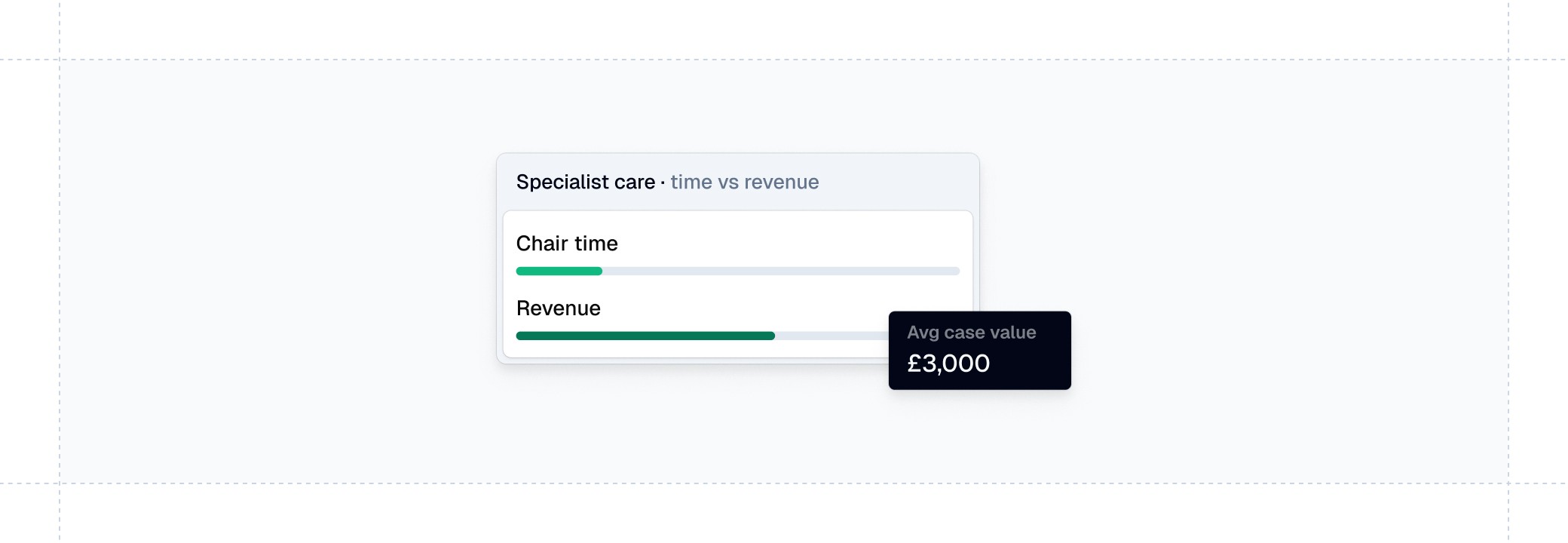
This generates: 50 × £3,000 = £150,000 or approximately 30% of annual revenue.
Importantly, these treatments consume relatively little chair time. Assuming approximately three hours of total clinical time per case: 50 cases × 3 hours = 150 hours.
Out of 1,600 available hours, specialist dentistry consumes less than 10% of total capacity. Yet it generates almost one-third of revenue. This is the defining characteristic of specialist dentistry: It contributes revenue disproportionately to the time it consumes.
Step 2: The Preventative Engine
Next comes routine care: Check-ups. Hygiene appointments. Preventative maintenance.
Assume:
Average revenue per visit: £75
Two visits per hour
This produces: £150 per chair hour. If we allocate approximately 1,000 chair hours annually to preventative care: 1,000 × £150 = £150,000. Again, approximately one-third of annual revenue.
At this point the surgery has generated:
£150,000 specialist revenue
£150,000 preventative revenue
Total: £300,000 with 1,150 chair hours consumed.
Step 3: The Restorative Layer
The remaining challenge is generating the final £200,000. After specialist and preventative care, approximately 450 chair hours remain available.
These hours are typically filled with treatments such as:
Crowns
Root canal treatment
Larger fillings
Whitening
Composite bonding
Similar restorative and cosmetic procedures
To generate the remaining revenue: £200,000 ÷ 450 hours requires approximately: £445 per chair hour. This is entirely achievable within restorative dentistry. Many of these procedures comfortably exceed £400 per hour when priced appropriately.
The result is a balanced model that does not rely on extreme assumptions.
What the Model Tells Us
The surprising insight is not that specialist dentistry matters. Most dentists already know that. The surprising insight is how little specialist dentistry is actually required. Only 50 specialist cases per surgery annually produce almost one-third of total revenue.
That is approximately:
One specialist case per week
Four to five specialist cases per month
The model does not require a referral centre. It does not require celebrity dentists. It does not require a marketing machine. It simply requires a practice that consistently converts appropriate patients into higher-value treatment plans.
The Likely Reality
In practice, the most successful businesses will probably lean slightly more heavily into specialist dentistry. Increasing specialist activity from 50 cases to 60 cases annually adds another £30,000 of revenue per surgery.
This reduces pressure on restorative dentistry and lowers the percentage of patients who need to proceed with fillings, crowns, whitening or similar treatments. For that reason, the most resilient £2 million practices are likely to over-index slightly toward specialist care.
Not because specialist dentistry is the entire business. But because it creates the economic breathing room that makes the rest of the model work.
The Emerging Picture
The treatment mix of a £2 million practice begins to look remarkably balanced:
One-third specialist dentistry
One-third preventative care
One-third restorative and cosmetic dentistry
The exact percentages will vary. The principle does not. A successful practice is not built on specialist treatments alone. Nor is it built on routine care alone. It is built by combining both in a way that maximises revenue per chair hour while remaining clinically appropriate for the population it serves.