•
Finance
Patient Finance: Why “Frictionless” Is a Myth — and What Actually Works
Chapter Two
The ambition—and the reality
In healthcare, systems are expected to work for all patients.
This includes:
different age groups
varying levels of digital literacy
and different levels of comfort with financial products
In theory, this suggests that:
the patient journey should be frictionless and universally accessible.
In practice, this is not achievable.
Friction cannot be eliminated
Even within a single demographic:
some patients are confident using digital tools
others are not
some are comfortable sharing financial information
others hesitate
Certain elements of finance applications inherently introduce friction:
terminology
data entry
identity verification
affordability checks
These are not design flaws.
They are structural requirements.
Designing for the majority, not the exception
The objective is therefore not: to eliminate all friction
But: to optimise for the majority of patients, while supporting edge cases effectively.
The most important decision: the device
Across large-scale application data, one pattern is clear: the patient’s own mobile is the dominant device.
Patients can technically apply via:
desktop
tablet
practice computer
or paper-based processes
In practice:
80%+ of applications occur on mobile devices
Why mobile wins
Mobile applications are:
faster
more familiar
and require less effort
Because:
personal data is pre-stored
addresses auto-fill
payment details are readily available
Key insight: Applying via mobile is approximately 2x faster than desktop.
Where applications actually happen
Patients do not always complete applications immediately in-practice.
Instead:
some apply during the visit
others apply shortly after
most complete within a short time window
Data insight
~90% of patients who receive a link start the application
~97–99% of those who start complete it
~90% of completed applications occur within 24 hours
Interpretation
When intent exists, completion is extremely high. The challenge is not the form.
It is maintaining momentum.
The hidden friction: delivery and connectivity
One of the most overlooked constraints is not UX—but infrastructure.
Key risks include:
delayed or missed emails
spam filtering
weak mobile signal
complex Wi-Fi access
Practical implication
Practices must ensure:
reliable 4G/5G coverage
or fast, frictionless Wi-Fi access
Without connectivity, even a well-designed journey fails.
UX design: reducing avoidable friction
Where friction can be reduced, it should be.
Key principles
1. Minimise required fields
fewer inputs → higher completion
2. Design mobile-first
optimised for small screens
3. Use simple inputs
radio buttons over dropdowns
clear progression
Decisioning: a layered system
Not all patients will pass initial checks.
Common issues include:
incorrect data entry
missing credit data
unverifiable income
The solution: layered decisioning
Instead of rejecting applications:
automated decision
open banking fallback
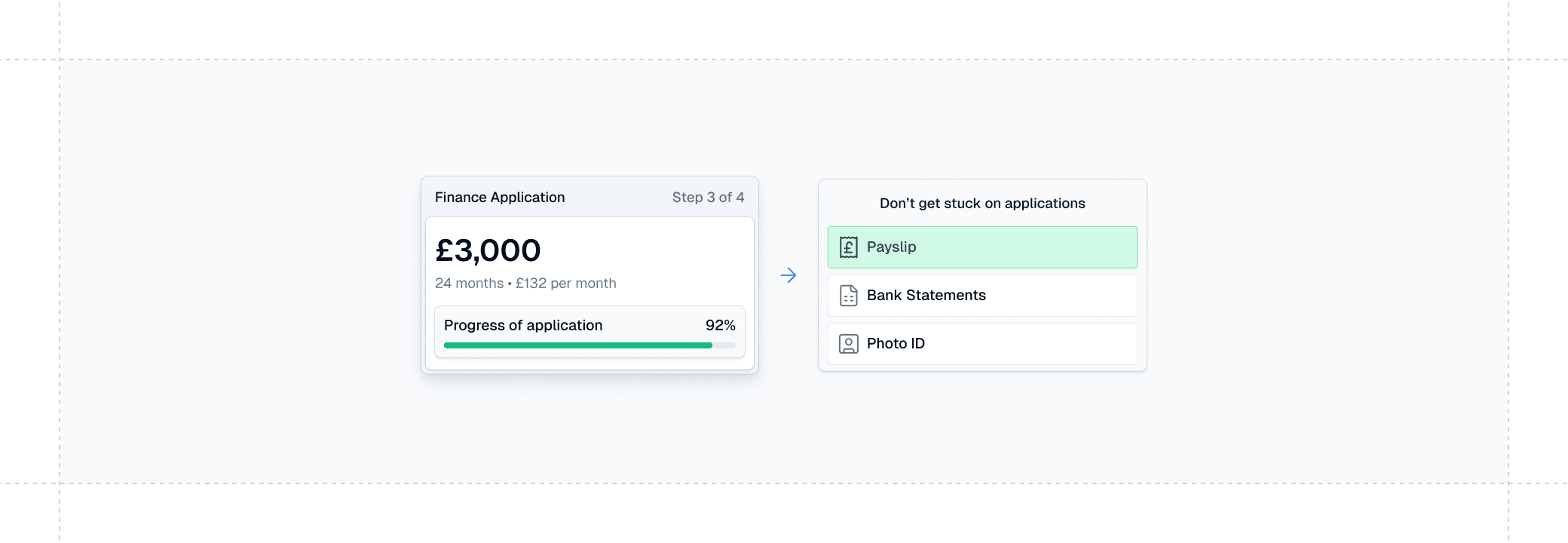
document upload (e.g. payslips)
identity verification (e.g. photo ID)
Key metric
Best-in-class systems achieve 95%+ automated decisions
This is particularly achievable in dentistry due to:
low fraud rates
high applicant quality
The risk of sequential friction
Fallbacks are necessary—but introduce risk.
Each additional step:
increases effort
and reduces completion probability
Design implication
Fallbacks must be:
efficient
minimally sequential
and clearly guided
Completion friction: intent is not completion
Unlike card payments, finance introduces a delay between:
decision
and completion
Even after approval:
not all patients complete immediately
Why drop-off happens
In most cases, non-completion is not due to:
rejection of treatment
It is due to:
distraction
interruption
competing priorities
Examples include:
leaving the practice
commuting
attending other commitments
Key insight: Non-completion often reflects loss of momentum—not loss of intent.
The limits of automation
Automated nudges (email, SMS):
are necessary
and effective
But they are:
generic
and not context-aware
They cannot fully replace human follow-up.
Active management: the missing layer
Practices that maximise finance conversion do not treat it as:
a one-step process
They treat it as:
a managed journey
What this requires
real-time application tracking
visibility into patient status:
started
submitted
approved
pending completion
regular review (daily or weekly)
targeted follow-up
The role of the practice
Practice teams (TCOs, reception, managers) can:
reconnect with patients
address treatment-related questions
and guide next steps
Importantly:
follow-up is rarely about finance itself
It is often about:
treatment clarity
timing
or reassurance
A critical operational gap: booking behaviour
One of the most overlooked differences between:
card payments
and finance
is how booking is handled.
Card payments
payment is immediate
appointment is booked instantly
Finance (in practice)
Even when:
the patient is present
approved
and committed
many practices:
delay booking
and wait for funds to be received
The misconception
There is a common belief that: finance requires a “cooling-off period”
This is incorrect in an in-practice setting.
The consequence
Patients who choose finance often experience:
delayed booking
additional waiting
and unnecessary friction
Effectively:
they receive a worse experience than card-paying patients
despite committing to the same treatment.
The implication
This is not a regulatory issue.
It is: a training and process issue
The opportunity
Practices can:
treat approved finance patients the same as card payers
confirm and book appointments immediately
maintain momentum from decision to treatment
Key insight: Conversion is not complete at approval—it is complete at booking.
Final takeaway
Patient finance does not fail because:
patients do not understand it
or applications are too complex
It fails when:
momentum is lost
processes are fragmented
and responsibility is unclear
The objective is not to eliminate friction.
It is to:
design for the majority
support edge cases
actively manage completion
and maintain momentum through to booking
Transition
If Chapter 1 addressed: how finance is offered and Chapter 2 addressed: how it is completed
the next question is: how finance should be positioned within the treatment conversation itself