•
Finance
Market Structure & Competition - A fragmented system shaped by brokers, lenders, and uneven control
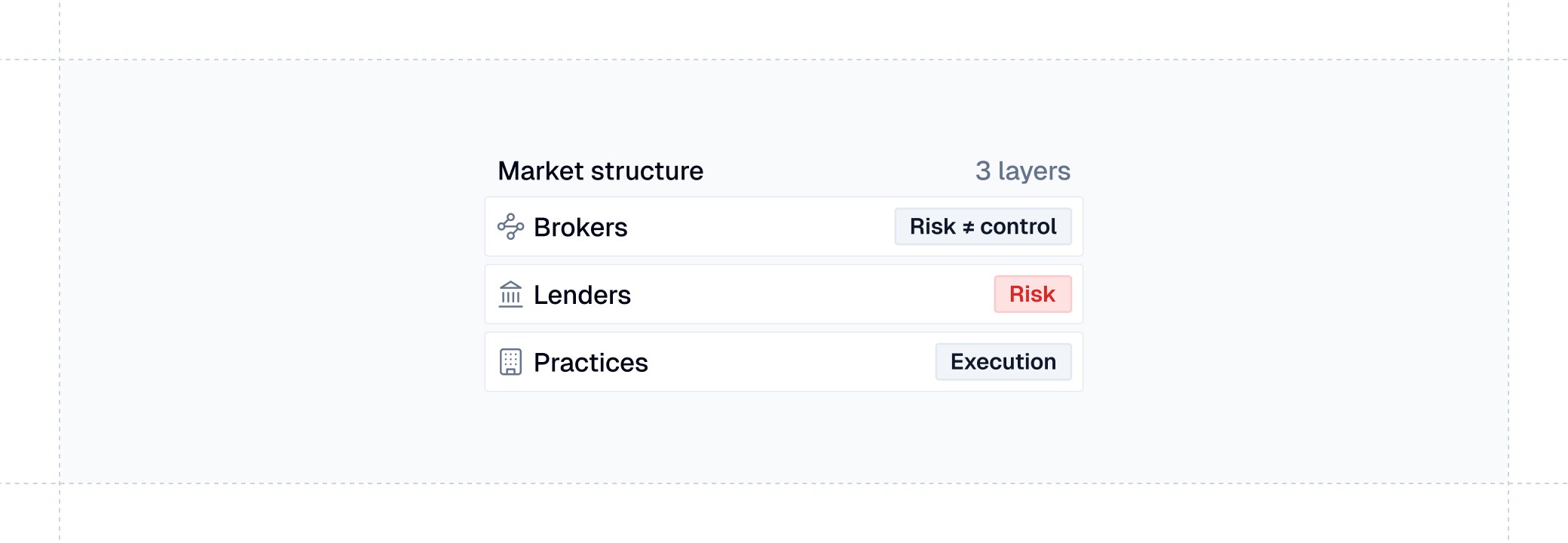
A fragmented system shaped by brokers, lenders, and uneven control
This is a market built in layers — not as a system
The UK dental patient finance market did not evolve as an integrated system.
It developed in layers:
brokers built distribution
lenders provided capital
practices executed the journey
At no point did a single player control:
the full patient journey
underwriting inputs
pricing consistency
operational workflows
Result
The market functions — but without alignment between risk, control, and execution.
1. The broker-led foundation
For most of its history, the market was dominated by:
Medenta
Chrysalis Finance
Dental Finance / Financing First
How the model worked
brokers:
owned relationships with practices
distributed finance
lenders:
funded loans
carried credit and Section 75 risk
Key lender relationships (historically)
Hitachi (now Novuna)
Close Brothers Retail Finance (Braemer brand in dentistry)
Shawbrook (earlier phase)
Structural characteristic
The entity originating the loan did not control capital or underwriting.
2. Medenta: persistent distribution, constrained funding
founded ~2006
acquired by Wesleyan / Practice Plan (c. 2011–2012)
Evolution
initially brokered via lenders (primarily Hitachi)
briefly operated with internal bank funding
lost this when Wesleyan exited banking
Current structure
operates primarily via V12 (Secure Trust Bank)
tripartite relationship: practice ↔ Medenta ↔ V12
Important clarifications
Medenta did not operate the AR model (this was Chrysalis)
relies on lender infrastructure for:
underwriting
capital
core systems
Additional context
longstanding relationship with Hitachi ended
legal dispute historically impacted positioning
currently limited lender optionality
Structural observation
Medenta controls distribution—but not capital, underwriting, or system design.
3. Chrysalis: consolidation and shift toward balance sheet lending
emerged alongside early Medenta expansion
scaled across:
dentistry
hospitals
Key structural moment
Dental Finance / Financing First merged into Chrysalis (c. 2021–2022)
driven by loss of funding partners
Funding evolution
historically:
worked with multiple external lenders (incl. Hitachi and Omni Retail Finance)
relationships repeatedly broke down:
particularly around risk exposure
Current direction
moving toward:
internal lending structures
balance sheet control (e.g. Citi-backed vehicles)
Structural observation
Chrysalis has shifted from broker to lender—but without fully rebuilding the system layer.
4. Close Brothers: exit following loss exposure
operated via Close Brothers Retail Finance
dentistry accessed through:
Braemer brand
Key events
Scandal related to Purplebricks feature on Dave (TV)
exposure to Finest Dental collapse (~2020)
Outcome
incurred material losses
subsequently:
sold its retail finance loan book
exited the sector
Structural observation
Loss events directly triggered exit from dentistry.
5. Novuna (Hitachi): scale with selective participation
large-scale retail finance lender
part of Hitachi group
Characteristics
very low cost of capital
strong position in large enterprise relationships
Key events
exposure to:
Dentix collapse
significant losses influenced:
withdrawal from smaller dental practices
Current positioning
focused on:
large corporate groups (e.g. Bupa)
reduced presence in:
independent practices and small groups
Structural observation
Participation is driven by scale and risk concentration—not market coverage.
6. V12 (Secure Trust Bank): stable capital, multi-sector focus
deposit-funded lender
significant scale in retail finance
Role in dentistry
primary funding partner for:
Medenta
Narrowed focus as other lenders withdrew
Observations
has not experienced the same level of visible losses in dentistry
maintains key relationships (e.g. mydentist, Medenta)
Structural characteristic
dentistry is:
one vertical among many
primary focus remains:
large-scale retail partnerships
Structural observation
V12 participates in dentistry—but is not dependent on it.
7. Failed and withdrawn entrants
Multiple entrants have attempted to enter dentistry and failed to scale:
Examples
Klarna → entered, then exited (fragmentation, low standardisation)
Affirm → explored, did not scale
humm (Australia) → limited traction
HSBC (Divido) → failed entry
Barclays → incomplete integration
BNP Paribas (Laser) → exited
Lloyds Bank → exited retail finance
Common challenges
fragmented provider base
variability across practices
lack of standardised workflows
difficulty underwriting consistently
Observation
Dentistry has consistently resisted generalist retail finance models.
8. Pricing: opaque and negotiation-driven
Historically, pricing has been:
non-transparent
inconsistent
negotiated individually
Observed behaviour
identical practices paying different rates
large groups not necessarily receiving best pricing
perception of value tied to negotiation outcome
Tabeo’s intervention (2018)
introduced:
public pricing
created:
a market benchmark
Market response
transparency adopted unevenly
pricing still largely negotiated
Structural observation
Until Tabeo, pricing has been determined by negotiation—not system logic.
9. Internal economics: opacity within groups
Within larger dental groups:
central teams negotiate supplier terms
associates share revenue
Observed practice
discounts not always passed through fully
pricing visibility managed internally
Structural observation
Opacity is maintained both externally and internally.
10. Technology: adapted, not purpose-built
Most systems in the market:
originate from:
general lending infrastructure
Characteristics
long application flows
desktop-first design
reliance on staff
Observed comparison
legacy:
~50–70 interactions
newer systems:
~20–25 interactions
Practical implication
patient often completes application:
with staff support
over extended time
11. Operational model: process-heavy and delayed
Finance operates operationally as:
a workflow
not an instant payment
Key components
Application
staff-assisted in many cases
Payout
requires: manual confirmation (legacy providers)
Observed delays
2–4 weeks payout cycles
even in large organisations
Reconciliation
separate from PMS
manual matching required
Structural observation
Finance introduces operational overhead beyond the transaction.
12. Regulatory baseline (pre-2026)
Before July 2026:
significant share of lending:
under 12 months
interest-free
Which meant
not FCA regulated
no Section 75 exposure
no Financial Ombudsman escalation
Effect
reduced compliance burden
lower perceived risk
Final observation
The UK dental patient finance market has evolved through:
broker-led distribution
lender-funded capital
practice-level execution
And is characterised by:
fragmented control
inconsistent pricing
adapted (not purpose-built) technology
operational complexity
It is a functioning market — but not an integrated one.